ingridscience

Moon phases puzzle

Summary
Put images of the phases of the moon in the correct order.
Materials
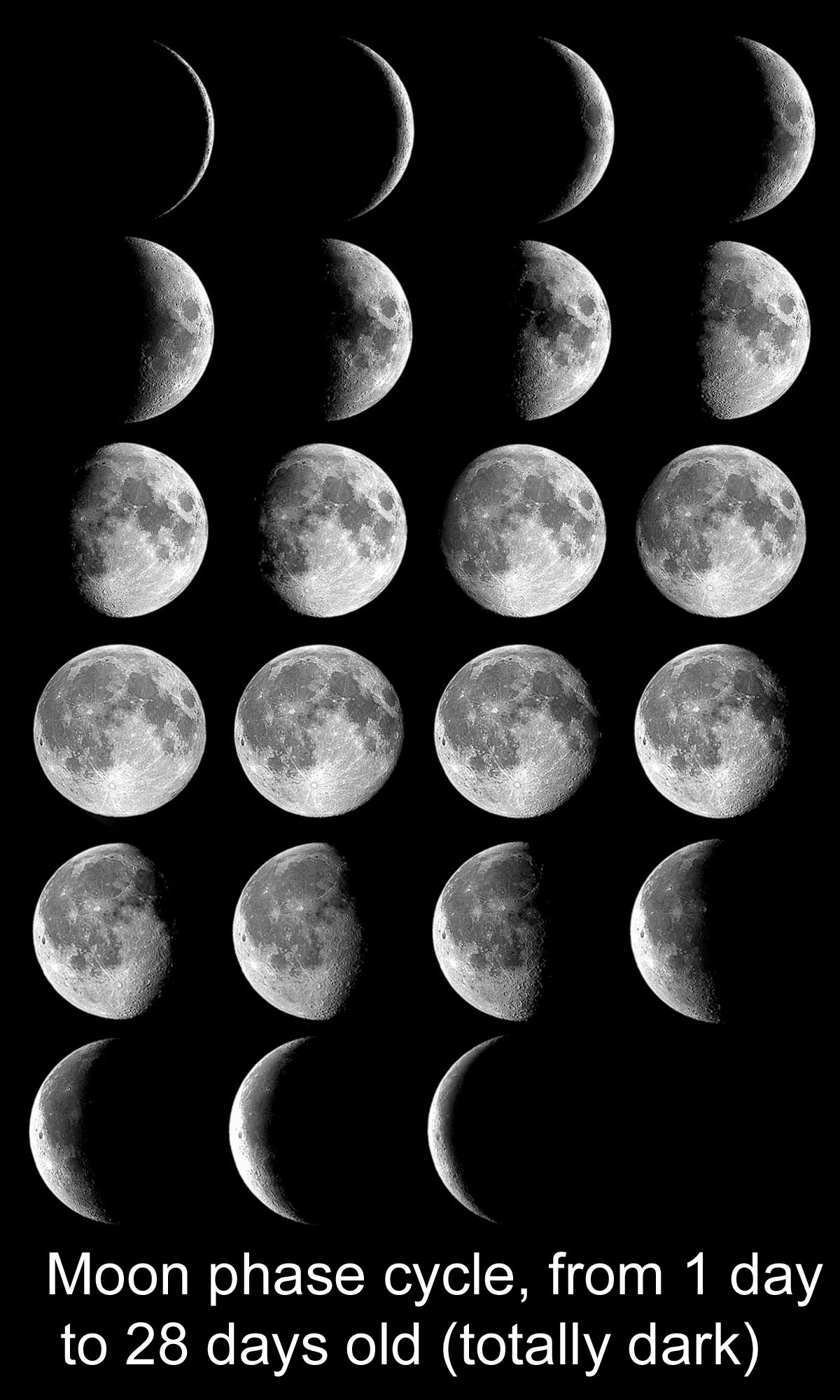
  • print out of moon phase images - I use this image from NASA, omitting some of the images
  • paper cutter or scissors
    Procedure

    Make a set of moon phases cards for each table group or each student.
    I use 16 images from a NASA page: https://spaceplace.nasa.gov/oreo-moon/en/Moon_phases_all_L.en.jpg

    Ask them to place them in order in a circle.
    Note that ordering these cards is tricky if one is not familiar with the sequence already. Depending on the students' prior knowledge of the phases of the moon, provide images to help them order their cards into a circle.

    Image of the phases of the moon around Earth, which students basically copy to place their cards: https://www.moonconnection.com/moon_phases.phtml

    Image of the Moon showing its features, so students know which way up to orient their cards: https://www.nasa.gov/centers/langley/images/content/528691main_Super_Mo…
    Interesting Moon features explained:
    Dark areas are lava flows from when the moon was younger (basalt).
    The round circles are craters from chunks of rock, or meteorites hitting the moon.
    All the mountains are formed by impacts, as the moon does not have tectonic plates.
    The moon has mountains and craters (tallest mountain over half the height of Everest on Earth).

    Depending on how hard the puzzle is for students, they can be started off with 8 cards (recommended for grade 3/4) and then add in the others.

    Notes

    Put an image of the Earth on each tub containing the cards, so it can be placed in the centre of the moon phases circle.

    Grades taught
    Gr 1
    Gr 3
    Gr 4
    Gr 5

    Evolution by natural selection

    Summary
    A running game shows the survival of a population depends on what it eats and what eats it. A camouflage challenge demonstrates how camouflage is a beneficial adaptation in both prey and predators. A relay race game shows how different bird beaks are adapted for carrying different foods. A lego-building activity shows how mutations result in a slow change in how an animal looks.
    Materials

    Materials in the activities

    Procedure

    Evolution is the gradual change in how living things look and behave as the generations cycle.
    If a living thing has a feature, or "adaptation" that helps it survive, it might live long enough to have babies, and the babies will inherit this adaptation.

    Adaptive changes happen through changes in DNA.
    (DNA is in every cell. It is translated into proteins, which build the body, or regulate body processes.)
    Tiny random changes in DNA (called mutations) sometimes change how a living thing looks or behaves.
    If a mutation results in an adaptation that is beneficial to the living thing, the living thing will live longer and have more babies. Those babies will inherit those same DNA mutations.

    To model how random DNA changes affect how an animal looks.
    Do the lego evolution activity.

    The camouflage activity (inside or outdoors) looks at one kind of adaptation (camouflage) which helps animals survive, whether they are a predator or prey animal.
    Look at photos of ptarmigan birds in summer and winter - they grow feathers with different colours in different seasons, for best camouflage.

    Natural selection game (outdoors or in large gym space) shows how populations shift as animals eat each other. (Suitable for all grades except Ks.)

    Show how adaptations allow animals to use different food sources: bird beaks eating different food types. Fun as a relay race outdoors/in a gym; also indoors as a non-running game.

    Notes

    Bird beaks great for Ks hand-eye coordination.
    Ks had fun with the camouflage activity though they tended to choose an environment that matched the clay, instead of making clay colours to match the environment (making it too easy to find the clay).

    Grades taught
    Gr K
    Gr 1
    Gr 2
    Gr 3
    Gr 4
    Gr 5
    Gr 6
    Gr 7

    Leaf growth patterns

    Summary
    Look at leaves growing from stems, and define the growth pattern as opposite, alternate or whorled.
    Materials
    • streets or outdoor space with several trees and/or bushes
    • optional: App or book for identifying the plants
    • optional: clipboards and paper for students, paper or portable white board for teacher
    Procedure

    Take students outdoors where there are several bushes and trees.
    Show students how to identify the pattern of leaves on the branches of trees or bushes - look a little way down the stem where the leaves are more spaced out. In the winter, when deciduous leaves have dropped, look at the pattern of the leaf buds. Draw on paper/portable white board to make the pattern clear.

    Alternate: one leaf emerges from one side of the stem, the next leaf along from the other side.
    Opposite: two leaves emerge from the same place on the stem, but on different sides.
    Whorled: several leaves emerge from the same place on the stem.

    Identify the trees as they are studied.
    I found this free Vancouver Street Trees iphone App which identifies trees on Vancouver streets by location.

    Students can use a map to mark where they found each kind of pattern.
    Or they can make a Venn diagram of the plants they find and the growth pattern(s) they exhibit.
    Note that different students may see different patterns in the same tree. Sometimes the patterns are not clear, especially if the leaves are close together at the tip of the stem.

    Extension: look at the patterns of the veins in leaves (opposite or alternate) and compare to the leaf growth pattern from the stem in the same plant.

    Discussion:
    Although leaves have different patterns in how they grow, all the patterns ensure that the leaves are well spaced out around the stem. This allows each leaf to catch as much light as possible for the plant.
    Through evolution, leaves that spread their leaves out were at an advantage over other plants, and this adaptation persisted.

    The actual mechanism for leaf growth patterns (called phyllotaxis) involves a molecule called auxin, and is a current area of research.
    Auxin is constantly flowing up the stem towards the growing tip. Where there is a lot of auxin, a new leaf grows. Auxin is drawn towards where a new leaf is growing, and is pulled away from the surrounding areas, depleting them of auxin. This means, as more auxin moves up the stem, it collects in areas further away from the last leaf. Once enough auxin builds up a new leaf grows, on the other side of the stem from the last leaf.
    See this webpage for a visual: https://www.researchgate.net/figure/Model-for-the-role-of-polar-auxin-t…

    The growth of all living things is a result of their molecules flowing, interacting and changing, setting up patterns that we see in the structure of plants and animals e.g. patterns of ribs or body segments.

    Grades taught
    Gr 2
    Gr 3
    Gr 4
    Gr 5
    Gr 6

    Camouflage challenge

    Summary
    Hide modelling clay of different colours and learn about different kinds of camouflage. Can be run outdoors, or indoors in a visually busy space.
    Materials
    • either outdoors: area of grass, rocky ground, tree roots or other outdoor area with a somewhat complex texture
    • or indoors: classroom or common area which includes visually busy areas e.g. art supplies, board signage
    • square made from four pipe cleaners
    • modelling clay of different colours (including brown and black for outdoor activity)
    Procedure

    Please note that in a class of students it is likely that one of them is at least partially colourblind (1 in 12 males are colourblind). As this is an activity distinguishing colours, these students will not be able to tell some colours apart and perceive some colours differently, although the activity will be no less interesting for them. The common red/green colour blindness means reds and greens (or colours containing reds and greens such as browns) look similar. More information at colourblindawareness.org and colorblindguide.com/post/the-advantage-of-being-colorblind.

    This is an engaging activity. Student get involved in creating works of art that look like the surroundings.

    Demonstrate how to hide clay in the classroom or outdoors:
    Make a small ball of modelling clay of one colour, about the same size as the starting pieces. Mix colours to match a chosen spot in the classroom or outdoors.
    Place the pipe cleaner square around the clay piece, so that others know where to look for the clay. The clay cannot have anything placed on top of it - it must be in plain sight.

    Give each student their own pipe cleaner square and a tub of modelling clay pieces in a variety of colours. Give more black and brown colours if working outdoors, to match the soil.
    Split the classroom or outdoor area in half, and the student group in half.
    Students hide their clay in one half of the area. Once they have hidden their clay and placed their pipe cleaner square around it, come back to the meeting spot. (This could be back at their desks if indoors, with camouflage pictures to look through while they are waiting for others to be done.)
    Once all students have hidden their clay, they can go and look for clay in the other half of the area. They should not touch or move anything in the squares, or they may accidentally cover up the hidden clay. They might also be asked not to point out the clay when they find it, so that others have the fun of finding it for themselves.
    After a while of finding hidden clay, all students can pick up their clay and square, then hide in the other half of the area. (Some may need renewed clay colours.)
    Continue for two or three rounds. Between rounds, explain the different kinds of camouflage, so that students can get more advanced in their hiding methods.

    The simplest kind of camouflage is "colour matching". Animals are often colour matched to their environment to make them harder to find.
    Another kind of camouflage is "disruptive colouration" where a living thing is more than one colour, maybe with spots or stripes. The different colours break up the outline of the living thing and make it harder to see.
    Another level of camouflage is to have an "irregular outline", so the shape of the object is not what is expected. Some fish have decorated heads, or insects look like a leaf.
    Students can try adding these layers of camouflage to their colour matching, by adding different colours of clay and changing the shape of their clay before hiding it. The final object should always be about the same size of the first ball (as a tiny speck of clay will be an unfair challenge).

    Examples of outdoor variations that students came up with: making a long piece of clay to look like a stick on the ground, or a piece of gray and black clay shaped to look like other little rocks on the ground, matching the colour of peeling paint on a fence, or even matching the colour of bird poop on a rock! (see this website for animals camouflaging to look like bird poop: https://www.sciencefocus.com/nature/heres-looking-at-poo-the-weird-and-…)
    Examples of indoor variations include hiding colours in a collection of coloured art supplies, or adding extra coloured patches to coloured tags. Posters or other flat materials are easier for finding hidden clay on, as the clay is the only raised part and reflects the light differently.

    Students can spend quite a while making works of art that can be a challenge to find by most in the class. Student groups and adults will enjoy visiting particularly challenging hides.

    Please note the likelihood of a colourblind student in the class. Colourblindness can also be an advantage:
    https://lifeonsphere.com/color-blind-people-can-spot-and-see-through-ca…
    https://www.science.org/content/article/eye-camouflage#:~:text=Being%20….

    Animals using different methods of camouflage:
    https://www.bbcearth.com/news/8-creatures-that-are-masters-of-disguise

    Webpages with lists of camouflage types:
    https://en.wikipedia.org/wiki/List_of_camouflage_methods
    https://www.eecis.udel.edu/~vijay/BLAST/Lesson_5.html

    Notes

    Ks have fun with this activity, though tend to choose their clay colour first, then find a place to hide it, which often makes it too easy to find. (Maybe limit their clay colours to those in the environment?)

    Grades taught
    Gr K
    Gr 1
    Gr 2
    Gr 3
    Gr 4
    Gr 5
    Gr 6
    Gr 7

    Rain gauge

    Summary
    Build a simple rain gauge from a recycled bottle and measure rainfall.
    Materials
    • 2L plastic drink bottle
    • scissors/sharp blade
    • ruler, or ruler scale duplicated onto a plastic sheet
    • clear tape
    • clean rocks
    • 2 mini binder clips
    • optional: smaller tube that fits over the mouth of the drink bottle, electrical tape and fine sharpie
    Procedure

    NOTE: this activity has not been tested with a class of students. Please contact me with suggestions if you try it with students.

    Cut the top off the 2L bottle, where the neck widens to the main body.
    Tape a ruler on the inside of the bottle, the numbers facing outwards, with zero at the base of where the sides are parallel.
    Add clean rocks (to weigh it down) then place in a shady location (to minimize water evaporation) with open sky above (no nearby wall or overhanging branches). Insert the top of the bottle upside down, and clip together.
    Make sure the rain gauge is sitting level, then fill with water until the water line is at the zero on the ruler.

    Hourly (if there is a lot of rain) or daily/weekly, read off how much rain has fallen. After each reading, either take apart and reset to the water line at zero on the ruler, or record the difference in mm of rain from the last reading.
    Tabulate and graph the readings.

    Optional set up to get more accurate readings:
    Attach a narrow tube to the mouth of the bottle, so that the depth of water will change more dramatically for smaller readings.
    Before adding the tube to the system, calculate the scale to add to the tube: calculate the relative surface area of the circles at the top of the 2L drink bottle and the small tube. This will be the relative difference between the spacing on the two scales (e.g. if the 2L bottle circle is 4 times larger, the scale on the small tube will be 4 times more spaced out). Calculate and write a new scale on electrical tape and tape to the side of the narrow tube, before inserting on the mouth of the bottle. Then clip the rain gauge together, as before.

    To give a sense of what readings to expect, light rain is only 1mm an hour or less. To read 5mm in an hour it needs to be steady solid rain.

    Note that despite the placement of the rain gauge, there will be some evaporation, so readings will not be as accurate as a professional rain gauge. A professional rain gauge style is "tipping bucket" - the rain fills up a little bucket, which is dumped and counted as it becomes full, hence there is way less sitting water to evaporate.

    Density, buoyancy and pressure

    Summary
    Understand density in terms of molecules, and how varying densities determine how buoyant things are and what pressure is.
    Materials
    • materials in each of the activities
    • a kitchen scale and graduated cylinder/beaker to measure density
    Procedure

    Review density:
    Density is how heavy something is compared to its size. Density depends on how close the molecules are together and what kinds of molecules make up an object.
    In solids the molecules are closer together, so solids are generally more dense than liquids, which are generally more dense than gases i.e. a desk is heavier than the air, a rock is more dense than water. Explained in another way, the rock sinks in water because the mass of the rock is greater than the same volume of water that it replaces. Its weight (the force of gravity pulling on its mass) is greater than the upwards force from the water (force of buoyancy).
    Sometimes a solid can float on water e.g. a piece of wood. This is because wood has tubes running through it (filled with sap when the tree is alive) which fill with air when wood is dried out. The overall density of a piece of wood is the combined densities of the wood and the air it contains. If this is less than the density of water, the wood floats. (Some kinds of very dense wood, even when dried out, sink.)

    Students try the dancing raisins activity at their desk, in smaller tubes, and think about why they move up and down. Then do a larger demonstration in a cylinder, while discussing why they dance.

    Sinking floating challenge 2. Once students have added just the right amount of nails/paperclips/modelling clay to their styrofoam piece to make it float half way down in the water, calculate its density, and compare to the density of water (1g/ml). The answers should be similar.

    Discuss pressure:
    When a gas (or liquid) is compressed to bring its molecules closer together, it exerts a pressure on the walls of its container.
    Do an activity that exploits pressure:
    Stomp rocket.
    (Pressure in a bottle and popcorn also good pressure experiments to add here.)

    Grades taught
    Gr 5
    Gr 6
    Gr 7

    Motor free play

    Summary
    Build motors into electric circuits and use card stock to make fans, buzz saws and spin art.
    Materials
    • wires cut from holiday light strings (I do this), or purchased electrical wires, or home made wires
    • batteries, I use AA size
    • small hobby DC motors e.g. from BCRobotix (I use this one) or try CanadaRobotix
    • optional but recommended: motor trays (provide a flat surface to attach card to) I use this one
    • masking tape
    • white card stock and scissors
    • marker pens
    • optional: pipe cleaners and other found light craft materials
    Procedure

    Before class: if you have motor trays, attach them to the motor shafts
    I also spend some time soldering more sturdy wires to the manufacturers motor wires, then zip-typing them to the side of the motor so that they can't be flexed back and forth at the joins.

    Students build a motor into a simple electric circuit: a battery and motor, connected into a loop with wires, using masking tape to attach the wires to each component. When the loop of the circuit is closed, the shaft on the motor will turn, but often so fast that it might be hard to see - put a piece of tape on it (or on the motor tray) to see it turn.

    Once students have their motor working, show them the card stock and other materials, which they can tape to the shaft of the motor.
    Ideas:
    Fan - a small circle of card cut to make angled blades, which blow air.
    Saw - a small circle of card with a serrated edge can cut through a piece of tin foil or thin paper (held taught).
    Colour wheel - add colours to a circle of card. Attach the card to the motor tray to make it spin. The colours blur together.
    Spin art - tape a 1/4 sheet of white card stock to the motor tray, then hold a marker to the card as it spins. Cut out afterwards.

    Students can also add holiday lights into the circuit - see the helicopter in the last photo.

    Notes

    If it becomes harder to make good connections, the wire ends may have become tarnished as the metal oxidizes in the air. Sand off the wires until they are shiny copper metal again.

    Idea: Use motors to spin discs with different colour segments on them, to understand colour mixing.

    Grades taught
    Gr 3
    Gr 4
    Gr 5
    Gr 6
    Gr 7

    Physical changes introduction

    Summary
    Manipulate materials and decide if the physical change is reversible or not. Then make ooblek.
    Procedure

    Introduction to physical change stations, followed by discussion of which physical changes are reversible.
    Make ooblek - a physical change. It is reversible and can be seen when water evaporates from a small drop of ooblek leaving the powdery cornstarch behind.
    Study a physical change, water changing state, in more detail, by measuring the temperature of water in different states.

    Grades taught
    Gr 2

    Anemometer

    Summary
    Build a simple cup anemometer to measure wind speed. Blow on it to make it spin.
    Materials
    • pieces of styrofoam, about 2cm x 2cm x 4cm (blue insulation foam works well)
    • small pen cap or tube, that can be pushed into the end of the styrofoamfoam piece
    • short skewers
    • cardboard egg cartons
    • hot glue gun
    Procedure

    Prepare the foam ahead of class:
    Make a small hole with scissors in the end of a piece of foam and push the tube/pen cap into it. A skewer inserted into the tube allows the foam to spin freely on the skewer.
    Make small holes in an egg carton cups and push a skewer through them. Hot glue the skewer in place. (Note: the skewers are a little long in the photo - push them further through before glueing.)

    Students assemble their anemometer by pushing the cup skewers into the foam in a circle. Three or four cups work, but younger students may have an easier time spacing out four (one on each side of the foam piece). Ideally the cups are all facing the same direction - help younger students to assemble, and allow older students to experiment with cup placement.
    Insert a skewer (with no cup attached) into the hole that the pen cap/tube makes in the foam.

    Blow into the cups to turn.

    Try experimenting with different numbers of cups, and different strength of breath.

    A weather station anemometer has metal cups which are weather-proof. The speed of the spinning cups is recorded as wind speed.
    Real anemometer image: https://education.nationalgeographic.org/resource/anemometer/
    https://www.environmental-expert.com/products/eml-model-wsu1-wind-speed…

    Notes

    Wind speed with a ping pong ball on a string: https://www.howtosmile.org/resource/measuring-wind-speed

    Grades taught
    Gr K
    Gr 1

    Mountain landforms and their erosion

    Summary
    Build models of mountains from a simple contour map, read contour lines on a large map, then use sand and water to show how erosion shapes landforms.
    Procedure

    Sit around a paper contour map of local mountains/hills e.g. Vancouver North Shore.
    Map with heights also coloured: The colours help us see the heights, but we don't need it with the lines, or contours. The shape of the lines show the shape of the land.

    You'll build a model of a mountain from a contour map.
    Demonstrate then run Landform models.

    As students make their model they bring it, and their corresponding contour map to the tarp, and lay them down to build two identical landscapes - one of the landform models and one of the corresponding contour maps.
    As a class, look at the landscape and the contour maps. Refer back and forth while discussing and highlighting features of a contour map
    e.g. When lines are close together, a slop is steep
    e.g. When lines are far apart, a slope rises gradually
    e.g. A valley forms between slopes, and the contour lines go up and back across the valley
    e.g. a bay, a peninsular, a cliff
    Refer back to the local paper map, and find these landform features.

    Explain that Erosion makes these shapes in the land.
    Water, ice and wind wear away parts of the land to make valleys and other landform shapes.

    Watch erosion in action with the sand and water erosion activity, at table groups of four, or as a demonstration.
    Note that the Erosion model is sped up a lot - valleys form over thousands or millions of year (depending on the rock type).

    Maps needs to constantly change as the landscape changes.

    Grades taught
    Gr 2
    Gr 3
    Gr 4